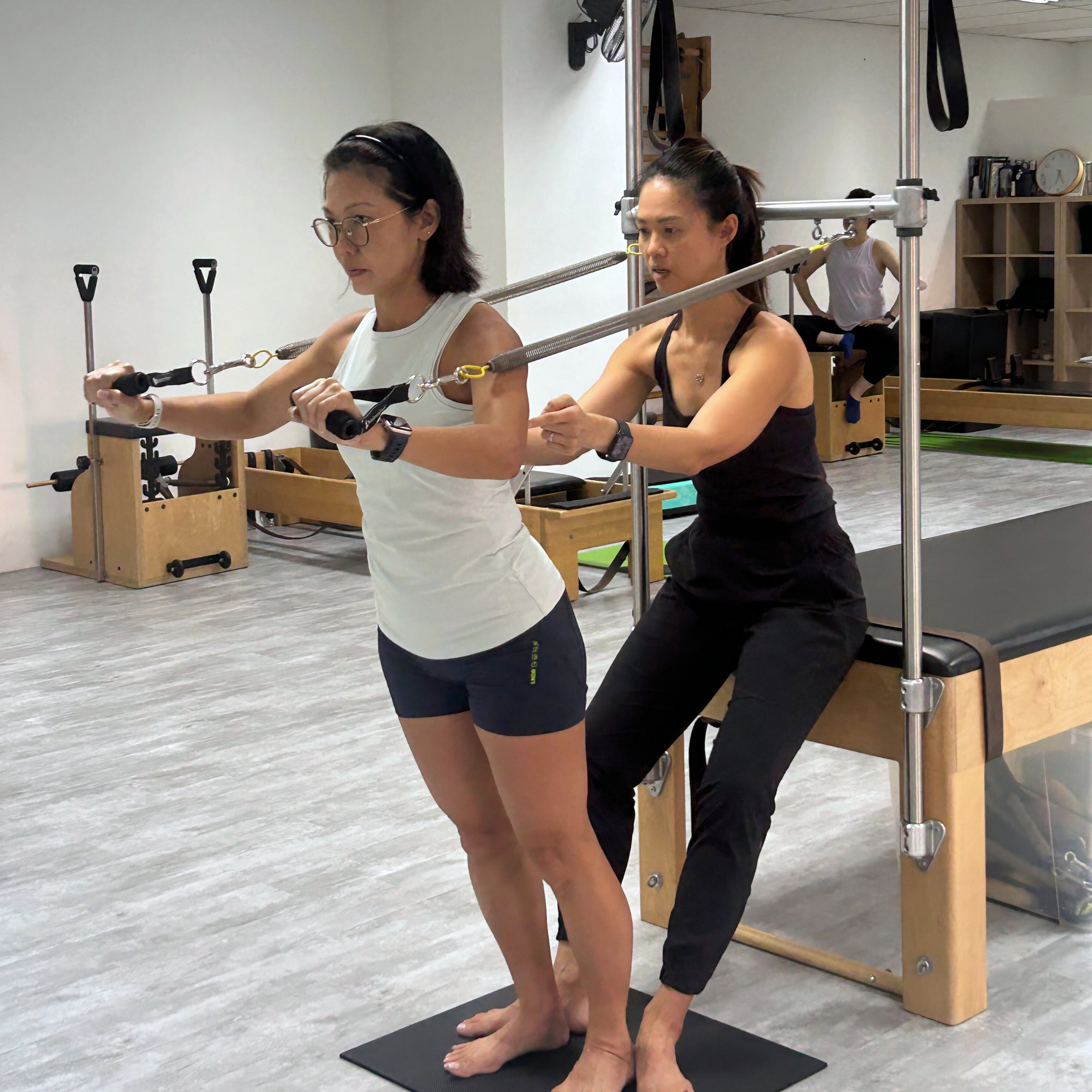
Most neck and shoulder pain doesn’t just start at the neck or shoulder. My life as a Pilates instructor is rarely that easy 😂
It usually comes from a stiff upper back and ribcage, which leaves the shoulder blade without a stable base, so the neck and upper shoulder muscles overwork. Pilates that restores upper back mobility, retrains breathing and builds shoulder blade control works on that root cause. “Sit up straight” doesn’t.
Tight neck by mid-afternoon. Shoulders creeping up towards your ears. A shoulder that pinches when you reach for the top shelf. When I ask people what they think is causing it, they’ll usually say the same thing: “bad posture.”
If that sounds familiar, you’re far from alone. A Singapore General Hospital study found that 73% of office workers in Singapore had pain in at least one part of the body. The neck (46%) and shoulders (42%) were on top of the list.
I hear this all the time at Pilates BodyTree, where I’ve spent almost 10 years helping people in Singapore move better after pain and injury. And as a climber, I know first-hand how much our shoulders have to carry, and how quickly things go wrong when they’re not supported properly.
That’s why I ran our Free Your Shoulders workshop. I wanted to answer a question most people have never had a real answer to: what does “bad posture” actually mean, and what can you do about it beyond “sit up straight”?
Here’s what I shared, and the one idea I hope you take away: your neck and shoulder pain rarely starts at your neck or shoulder.
Why doesn’t “sit up straight” fix my posture?
We’ve all been told to sit up straight since mugging for our exams in school. We pull our shoulders back, hold it for a few minutes, then slump again. And we conclude we just have bad posture.
Here’s the thing: sitting up straight is a position. It treats posture as one “correct” shape to hold. But if your upper back is stiff, you’re asking it to work to hold a fixed position. That’s why it feels like hard work and never lasts. You end up fighting the restriction instead of fixing it.
Forcing it can also just move the problem. If your upper back can’t straighten, “standing tall” often comes from arching your lower back or jutting your chin instead. The strain just gets relocated.
In the workshop this year, I reframed it like this:
We don’t work on posture to turn “bad” into “good.” We work on it to increase the number of postures you can access in a day.
A body with range doesn’t need to be forced into a good position. It can get there on its own, because nothing is blocking it.
Can you change posture that’s been there for years?
Not all posture is the same. Slouching at your desk is mostly a habit. It’s muscular and positional and it changes with the right work.
Other patterns can become more settled over years: a rounded upper back (kyphosis), a forward head, an overarched lower back (lordosis), a flat back, or a forward-tipped pelvis. Here, the joints and tissues themselves have adapted to that shape. Telling someone with a rounded upper back to “stand up straight” is not kindness.
And some cases are genuinely fixed. Conditions like ankylosing spondylitis come with real limitations. That’s not a reason to give up on movement. You work with your limitations, not against them.
So instead of chasing an “ideal” posture, I tell people to chase more range than you have right now, in every direction. Not just the one direction that looks “corrected.”
One more thing people are often surprised by: your sleep position counts too. It’s the posture you hold the longest without thinking. That’s why you get neck and shoulder aches from waking up some times. Make your sleeping position good, or at least not bad.
Why does neck and shoulder pain keep coming back?
Your shoulder is the most mobile joint in your body. That also makes it the least stable, and the most dependent on everything around it.
The picture I use is a crane:
- The base is your trunk, your spine and ribcage. If the base isn’t solid, the crane wobbles no matter how strong the arm is.
- The pivot point is your shoulder blade. If the pivot isn’t set right, the arm can’t move smoothly or lift safely.
- The crane arm is your arm bone. With a shaky base or a badly set pivot, the arm jams, strains and overworks.
When the base and pivot aren’t doing their job, something else steps in. Very often, that’s the muscles across the top of your shoulders and the back of your neck. They end up holding everything together, which is exactly where so many of us feel tight and achy.
This is why stretching your neck or strengthening your shoulder on its own often gives only short-term relief. If the base underneath isn’t addressed, the pattern comes back.
What does your ribcage have to do with shoulder pain?
Btw here’s a fun fact you might not have known: Your shoulder blade doesn’t attach to your spine. It sits on your ribcage and glides across it. So wherever your ribcage goes, your shoulder blade follows.
There are two common ways the ribcage gets stuck:
- A flared ribcage. The ribs jut forward, often with an overarched lower back. This is common in people who’ve been told to stand up straight and overcorrect by puffing out their chest. It looks upright, but it’s not neutral. It’s just a different kind of held tension.
- A collapsed ribcage. The ribs sink down and back, often with a rounded upper back. This is the classic slouch.
Either way, the shoulder blade loses its stable home base. That sets up the conditions for pinching (impingement), irritation of the rotator cuff, and strain in the shoulder joint.
To improve the home base, we work the upper back and ribcage in all four directions: bending forward, bending back, rotating and side-bending. When one direction is overused or underused, the whole structure gets stressed.
And breathing is part of this. Your breath literally moves your ribs from the inside. For people who can’t yet feel it through cues alone, directed breathing is often the first way in.
How does Pilates help neck and shoulder pain?
At Pilates BodyTree, to help with neck and shoulder pain the formula looks something like these 4 steps:
- Release and stretch
the muscles that have been overworking, like the tops of the shoulders and the chest.
- Mobility exercises
to restore movement in the upper back and ribcage, so your shoulder blade has a stable base again.
- Breathing
to retrain how your ribcage moves, from the inside.
- Muscular stabilisation
to strengthen the muscles that control your shoulder blade and joint, so the change holds.
The order matters. Strengthening a shoulder that’s sitting on an unstable base just reinforces the compensation.
What I find fascinating is that everyone’s restriction shows up differently. Some people are locked through the ribcage, others through the shoulder blade, others in specific muscles. The concept is the same, but your pattern is your own.
Can “keep your shoulders down” make shoulder pain worse?
It can, when it’s used for everything.
One of my clients came in with shoulder pain during clean and jerks and chest presses. In our first few sessions, we noticed something: before every shoulder exercise, he was pulling his shoulders down and back. Even in exercises that didn’t need it.
Somewhere along the way, he’d picked up the cue “keep your shoulders down” and applied it to everything. His muscles were getting confused signals. In a press or an overhead lift, the shoulder blade needs to move with the arm. He was clamping it in place instead.
So we refined his technique, exercise by exercise. The turning point was when he understood what he actually wanted his body to do in each movement, and where the generic cue had been misleading him.
After five sessions, he was lifting without pain. Even more importantly, he now understands when to increase the load and when to hold back.
It’s the same lesson as “sit up straight.” A one-size-fits-all cue can’t replace understanding how your own body is meant to move.
How do I start Pilates for neck and shoulder pain in Singapore?
Because everyone’s pattern is different, I always recommend starting with a 1-to-1 Mobility Fitness Assessment ($137). We look at how your joints move, which muscles are overworking and where you’re compensating. Then we build a plan that fits your body, not a generic routine.
A quick note on safety: if your pain is new, sharp or getting worse, or you have numbness or tingling down your arm, please see a doctor or physio first. Our Pilates studio is well-regarded by local physiotherapists, and we partner with physios and the National Arthritis Foundation. Many of our clients come to us once they’ve finished physio but don’t yet feel ready to get back to work, sport or the gym.
For many people, yes. Most ongoing neck and shoulder pain comes from how the upper back, ribcage and shoulder blade work together. Pilates retrains that, so your neck and shoulders stop overworking.
Not by sitting up straighter. Building range in your upper back, your breathing and your shoulder control changes your posture in a way that lasts.
It can be, when it’s adapted to you. We work within a comfortable range and start with the base before loading the shoulder. If you’re under a doctor’s or physio’s care, check with them first.
Absolutely. Many of our clients start with no Pilates or fitness background. We begin from where your body is today.
