Is Pilates Good for Lower Back Pain?
“My back hurts. Is it safe for me to exercise, and can Pilates help me?”
We get asked this a lot. If you’re someone who has back pain, herniated or slipped disc or even spondylitis you have probably been told to “strengthen your core” by at least one person. And you’ve maybe tried to work on your core by doing things that can help! Like crunches, or planks. Right?
The thing is, that advice is probably jumping the gun. “Strengthen your core” is simplifying the issue and doesn’t really help you understand your body. A better answer could be “Try Pilates”, or more accurately, “Try one-on-one Pilates Personal Training”.
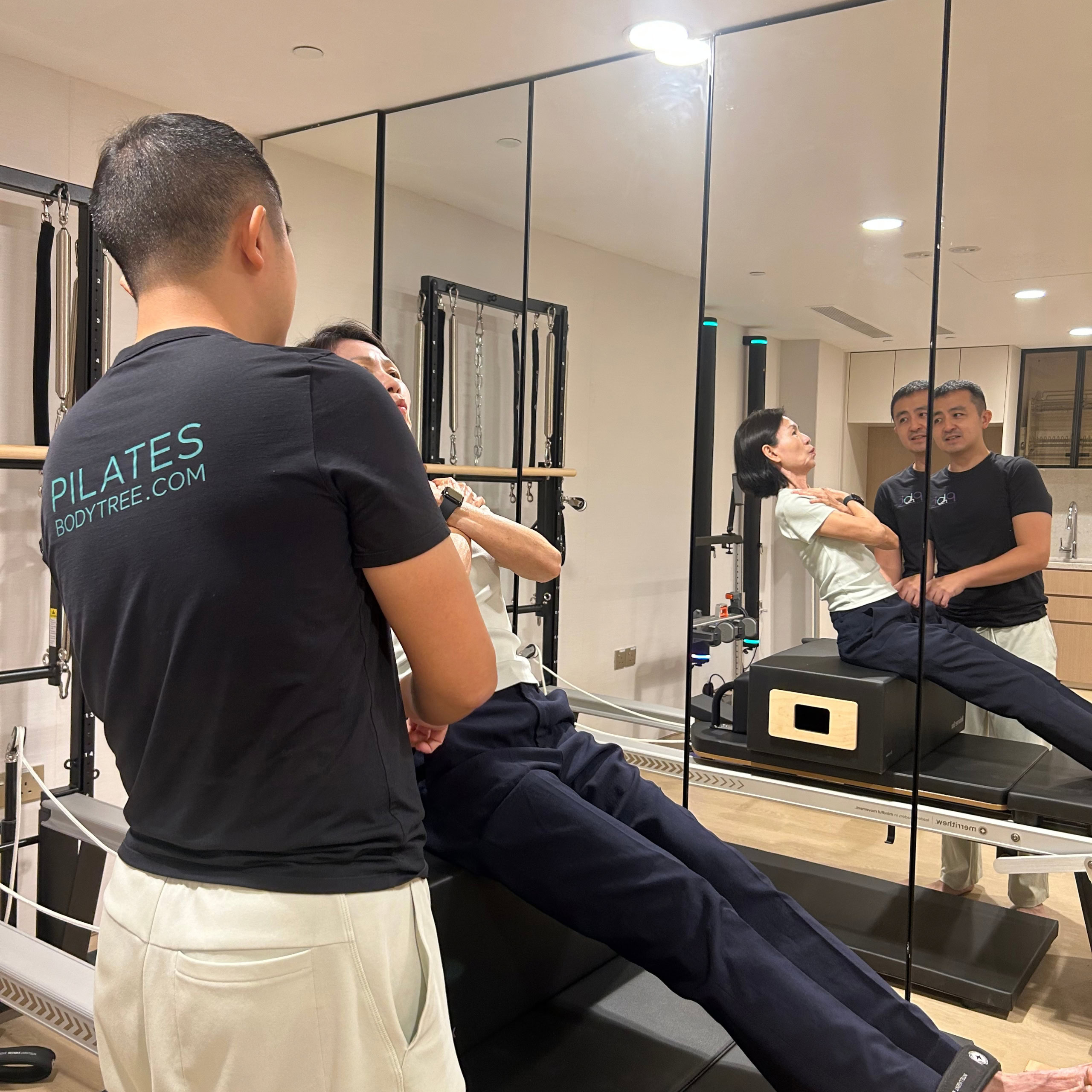
Pilates can help people with lower back pain. But what a teacher does in a one on one Pilates session depends on the person, the cause and stage of their symptoms, and what the teacher observes.
At Pilates BodyTree, we don’t believe that everyone with lower back pain needs the same set of exercises.
Two people can come to us with the same diagnosis, or describe very similar pain, and move very differently. They may also want completely different things from their bodies.
One person wants to sit through a workday comfortably. Another wants to pick up their grandchild. Someone else wants to return to the gym, golf, running or climbing.
We don’t typically begin with: “Which Pilates exercises are good for lower back pain?”
Sessions usually start by understanding what are you having difficulty doing, how are you moving now, and what do we need to help you get back to.
What does the research say about Pilates and lower back pain?
There is good evidence for exercise in general as part of the management of chronic lower back pain.
Clinical guidelines include different forms of exercise, including strengthening and endurance work, movement-control exercise, aerobic exercise and Pilates. However, research has not established one form of exercise as the best choice for everyone.
The World Health Organization also recommends structured exercise as one component of care for chronic primary lower back pain and emphasises that care should be tailored to the individual.
So Pilates is not a magic treatment for back pain. And now with the saturation of Pilates teachers in Singapore, the experience of your teacher matters greatly. Pilates is a versatile movement system with great foundational principles that gives us many ways to help someone move, build strength and gradually increase what their body can do.
It’s not always about having a “weak core”
As I mentioned, one of the most common things people with back pain are told is:
“You need to strengthen your core.”
Sometimes strength is part of the picture. But in our experience, back pain is rarely as simple as weak abdominal muscles.
As teachers, we have to look beyond the painful area.
We may look at how your spine moves, but also how your hips and pelvis move with it. We might look at how you transfer weight through your legs, how you organise yourself under load, how you breathe, and what happens when movements become more challenging.
Sometimes we find that someone has become very guarded around their back.
Sometimes they are strong, but repeatedly rely on the same movement strategy.
Sometimes another part of the body isn’t contributing well, so the lower back ends up compensating and doing more of the work.
And sometimes someone simply hasn’t moved very much for a long time because movement has become associated with pain.
The painful area is important but it is not necessarily the whole story. It could be a victim of something else that’s much quieter.
What makes Pilates useful for back pain?
One of the things we value most about Pilates is how adaptable it is.
An exercise doesn’t have to be simply “safe” or “unsafe” for someone with back pain.
We can change the position. Reduce the range. Add support. Change the resistance. Slow the movement down. Explore a different direction. Or choose another movement altogether. This is what good Pilates teachers do. This is what we are taught to do at Pilates BodyTree.
This allows us to find an appropriate starting point and then progressively increase the challenge.
How do we decide what to work on?
This is where assessment matters. When someone tells us they have lower back pain, we don’t want to assume that the lower back itself is the only place we need to work.
We want to build a more complete picture of how their body is working so our teachers assess things such as:
- which muscles appear weak or strong
- which muscles are tight or restricted
- which muscles may be overworking
- where mobility may be limited
- how different parts of the body work together during movement
- what compensation strategies the body may be using
For example, if one area isn’t contributing enough to a movement, another area may be doing more to compensate. That compensation isn’t necessarily “bad”. Our bodies are very good at finding ways to get things done but sometimes these strategies may be contributing to pain, overloading certain areas or limiting how efficiently someone can move.
Once we have a clearer picture, we can make the programme much more specific.
One person may need to release or stretch an area that is consistently overworking. Another may need more mobility somewhere else. Another may need to strengthen an area that isn’t contributing enough.
Often, it is a combination.
This is why two people who both tell us “I have lower back pain” may end up with very different Pilates programmes.
What if moving my back hurts?
This is where personalisation becomes particularly important.
Pain doesn’t automatically mean that you should stop moving altogether. For persistent lower back pain, current guidelines generally encourage appropriate physical activity and exercise.
But that doesn’t mean we ask someone to ignore pain and push through everything either.
When a movement doesn’t feel right, we want to understand what is happening.
Can we change the position? Can we make the movement smaller? Can another part of the body contribute? Can we reduce the load? Can we find another way into the movement that feels more manageable?
Sometimes it’s actually about getting a person in pain to get their mental state to:
“Oh. I can actually do this without being afraid of my back.”
From there, then we build.
Do I need private Pilates if I have lower back pain?
Not necessarily.
Someone with mild, well-managed symptoms who already feels confident exercising may be perfectly comfortable in an appropriate group class.
But if your back pain has been persistent, your situation is more complex, you have a history of injury or surgery, or you’re nervous about exercising again, we generally prefer to understand you individually first.
At Pilates BodyTree, that usually begins with a Mobility Fitness Assessment (MFA), or a Personalised Rehab PT.
We learn about your history, what currently bothers you, what activities you have stopped doing and what you would like to return to.
Then we observe how you move.
This gives us a starting point for deciding what you actually need from your Pilates programme.
What if I’ve already been to physiotherapy?
This is actually when many people come to us.
You may have completed physiotherapy and been told that you can return to exercise, but still not feel ready.
There’s quite a large gap between:
“My injury no longer requires treatment.”
and
“I trust my body enough to do everything I want to do again.”
In that case, Pilates can be useful for you.
We can progressively introduce more movement, strength, resistance, complexity and challenge as your capacity improves.
For some people, this happens after physiotherapy. For others, Pilates may complement ongoing care from their physiotherapist or another healthcare professional.
Our role isn’t to replace your physiotherapist or doctor.
Our role is to help you build movement capacity and confidence.
When should I see a healthcare professional instead?
There are situations where Pilates shouldn’t be your first stop.
Pilates teachers do not diagnose the cause of back pain.
If your pain is new and severe, worsening significantly, began after significant trauma, is accompanied by concerning neurological or other symptoms, or you simply don’t know what is causing it, an appropriate healthcare professional should assess you first.
The same applies if you’ve recently had surgery or medical treatment and have been given specific restrictions.
When your situation falls outside our scope, we would rather tell you that than pretend Pilates is the answer to everything.
So, is Pilates good for lower back pain?
Yes for many people, it can be.
Research supports exercise as part of the management of chronic lower back pain, and Pilates is one of several exercise approaches that can be used.
But after years of teaching people with different bodies, histories and goals, we’ve found the more useful question isn’t whether Pilates is good for back pain, but rather what is this body that we’re observing doing, and what does it need? Pain is your body trying to tell you something, and we are merely trying to figure what it’s trying to say to you.
That’s how we approach rehabilitation-focused Pilates at Pilates BodyTree.
We assess where you are now. We find movements you can succeed with. We build strength, mobility, coordination and confidence. And as your capacity grows, we progressively bring you closer to the things you actually want to do.
Not sure whether Pilates is suitable for your back?
Start with a Personalised Rehab PT if you’re more concerned about focusing on your immediate injury.
We’ll learn about your history, look at how you’re moving now, understand what you’d like to get back to doing, and determine an appropriate starting point.
Pilates BodyTree offers private and rehabilitation-focused Pilates at Orchard, Chinatown Point and United Square (Novena) in Singapore.
References
World Health Organization. WHO guideline for non-surgical management of chronic primary low back pain in adults in primary and community care settings.
George SZ, Fritz JM, Silfies SP, et al. Interventions for the Management of Acute and Chronic Low Back Pain: Revision 2021. Journal of Orthopaedic & Sports Physical Therapy. 2021;51(11)–CPG60.
